coMra Therapy — Eye Protocol
A foundational treatment to support optic nerve health and visual-field stability, with secondary benefits for overall neuro-vascular function.
Devices
- Recommended: coMra Pro 905, coMra Delta 905
- Optional: coMra Palm (for home-use follow-up)
The Pro and Delta deliver the same therapeutic radiances and parameters — choose by format and workflow.
Important: For Steps 1–2, eyes must be gently closed.
Treatment Structure
| Step | Area Treated | Time | Frequency |
|---|---|---|---|
| 1 | Closed eye (directly over upper eyelid) | 2 min/eye | 50 Hz |
| 2 | Facial scan (eye & optic-nerve pathway) (eyes closed) | 5 min/side | 50 Hz |
| 3 | Occipital area (visual cortex) | 1 min/side | 50 Hz |
| 4 | Carotid artery (side of neck) | 2 min/side | 5 Hz |
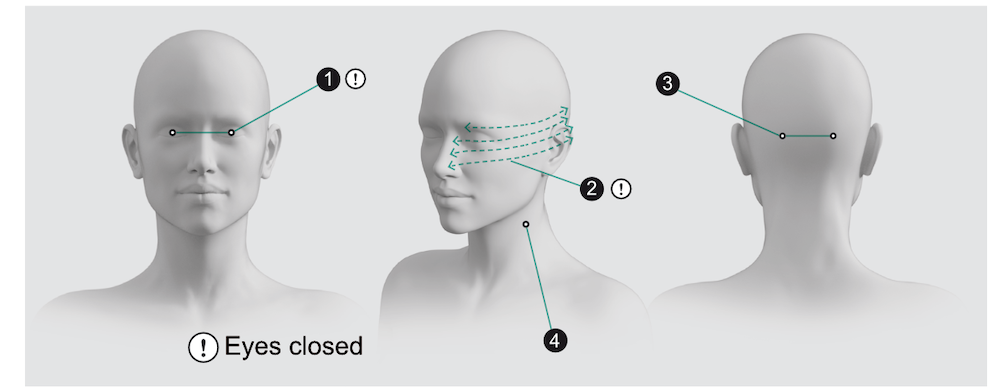
Total treatment time: ~20 minutes (before any adjustments).
Session cadence: Adapt to your model (e.g., weekly, biweekly, or integrated into VT/rehab blocks).
Safety & Integration
- When treating on or near the eyes (as in Steps 1 and 2), always ensure the eyes are gently closed.
- coMra is non-thermal and will not cause tissue damage.
- This protocol is safe, adjunctive, and integrates easily into in-office workflows or technician-led care.
Clinical Context — Where This Protocol Helps
- Early or advanced glaucoma
- Optic neuritis / ischemic optic neuropathy
- Post-stroke visual-field loss / suppression
- Diabetic ischemia, retinal degeneration
- Visual fatigue / stress-related suppression
Triage & Tailoring Options
This protocol can be adapted based on your clinical approach, time available, and patient needs.
Prioritize ocular regions
Focus on Steps 1 and 2 for direct support of the eye, optic nerve pathway, and extraocular muscles.
Streamline for vascular support
Include carotids (2 min per side @ 5 Hz) to enhance perfusion to the eye and brain.
This step is quick, comfortable, and well-tolerated.
CVA / neurotrauma adaptation
Include carotids (2 min per side @ 5 Hz) and 5 min @ 50 Hz directly over the site of insult or injury, plus optic nerve pathway scan on the affected side.
Typical sessions range 12–20 minutes. Choose the level that fits the patient and clinic flow.
Next Steps
-
View the Clinical Brief— case outcomes + integrated rationale
-
Ask a Clinical Question — get quick guidance on cases or protocol tailoring
-
Visit the Eye Home Page — hub for cases, protocol, and research