Energy · Transport · Rhythm in Neuro-Ocular Care
coMra delivers four low-intensity, non-invasive radiances simultaneously as one coherent therapeutic signal. The design is simple: restore conditions that facilitate tissue self-repair.
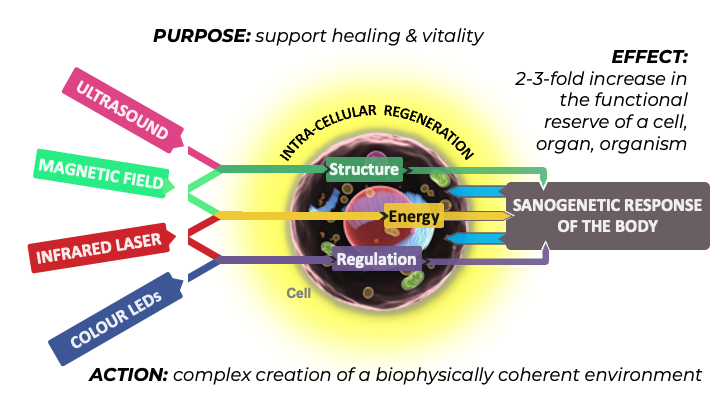
Energy · Transport · Rhythm: coMra’s simultaneous radiances support ATP, micro-transport, and regulatory rhythm in neuro-ocular tissue.
The four radiances — at a glance
- IR laser + magnetic field — ATP support for energy-limited neural tissue
- Ultrasound (≈40 kHz) — micro-transport & gentle restructuring
- Sequenced colour LEDs — informational pacing to re-sync rhythms
How the radiances work together (details)
Infrared laser + magnetic field
Low-intensity photobiomodulation supported by a steady magnetic field bolsters ATP and creates a neuroprotective milieu at very low power—helpful for metabolically loaded axons and glia.
Ultrasound (low-intensity, ~40 kHz)
Gentle mechanical oscillation improves micro-transport (diffusion, enzyme dynamics) and supports tissue restructuring—useful where perfusion limits recovery.
Sequenced colour LEDs
Monochromatic light in intentional sequence serves as rhythmic, informational pacing—helping re-sync autonomic/immune timing (calm activation vs chronic overdrive).
coMra does not “force a pathway.” It sets conditions—energy + transport + rhythm—so the body’s sanogenetic program can run.
What this means in practice
- Adjunctive: used alongside standard care; 10–20-minute staff-delivered sessions over closed eyelids
- Gentle: non-thermal, non-ablative; no tissue damage
- Tolerable: no observed adverse effects in long-term use when applied as directed
Early shifts often include easier visual comfort and a calmer overall state; with a course, clinics aim for functional resilience (e.g., support for field stability when energy is the limiting factor).
A note on the name
coMra = coherence through modulation of radiances.
It’s a description of the approach—not an acronym. We write coMra with a lowercase “c” (except at the beginning of a sentence).
Where to go next
- 📄 Eye Protocol — step-by-step delivery in clinic
- 📚 Case Highlights — representative outcomes in practice
- 🔬 Research Gallery — mechanisms & digests that underlie this approach
👉 Return to Eye Main Page